
URBANPOLL: Parallel adaptation of plants to URBAN POLLinators
Introduction
Urban areas are characterized by peculiar conditions when compared to non-urban ones and might represent “unintended but highly replicated experimental evolution systems” to test the resilience of plant species facing rapid anthropogenic environmental changes1. A growing interest is thus being paid to urban ecosystems with the aim of understanding how organisms might adapt to their abiotic and biotic conditions. While adaptations to abiotic urban factors have been well investigated, less is known about the selective pressures imposed by biotic interactions of plants in urban environments, in particular pollinators. In URBANPOLL I investigated how urbanization influences local adaptation of floral traits involved in pollinator attraction and whether this process follows parallel trajectories in urban areas across contrasting climates, using Trifolium repens (white clover) as a model species.
How do pollinator communities and floral traits (co) vary along urban gradients across Europe?
A large-scale field campaign was conducted in 2024 to measure plant traits in the field, collect and preserve inflorescences for measurements of floral traits, estimate seed sets from naturally pollinated infructescences, and observe pollinator diversity, abundance, and activity on T. repens. In total, I collected data from 87 populations distributed among 12 European cities in three bioclimatic regions (seasonally dry in the Mediterranean, continental in Central Europe, boreal in the Baltic), for over 1100 observed patches of T. repens and ~43h of pollinator observations. Urbanization gradients were inferred using 2018 CORINE Land Cover as the percentage of impervious surface in a 1000m diameter buffer zone. In the Mediterranean, urbanization had a negative effect on floral traits (inflorescence diameter, banner length), and trends of parallel adaptation were observed between cities. No general trends of floral trait variation were detected for the pooled data in Central or Baltic Europe, with different cities showing positive or negative response to urbanization (Figure. 1). This could be the result of urban greenery management policies in Central and Baltic Europe which produce highly heterogeneous urban habitats. Whereas pollinator community composition varied among geographic regions, urbanization did not have a detectable effect on pollinator diversity, activity, or abundance. Despite this, seed set decreased with urbanization in Mediterranean cities, whereas it did not show consistent trends in Central Europe. The results of the 2024 field campaign are summarized in a manuscript currently under revision in Functional Ecology.
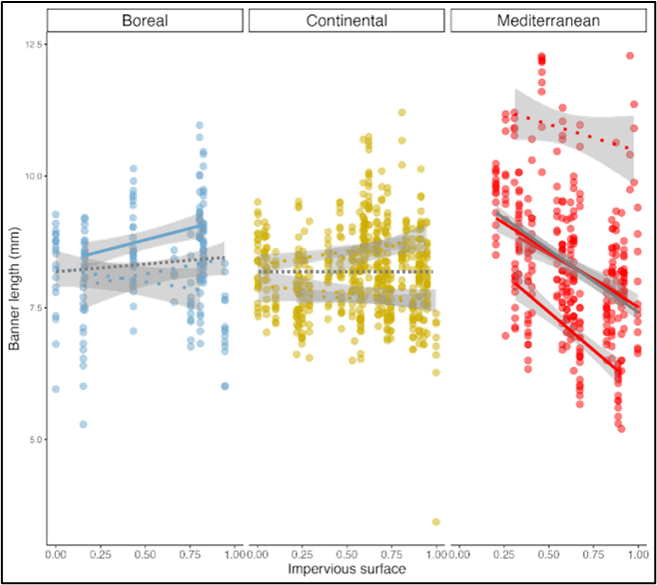
The seeds collected in the scope of the 2024 field campaign were used in two subsequent experiments. First, seeds from Mediterranean populations were grown in a common garden at the University of Naples. The floral trait differentiation documented between natural populations during field surveys was also observed in the common garden, suggesting a genetic basis for the observed patterns of variation in response to urbanization.
Next, in collaboration with Goethe University Frankfurt, I am currently running a germination experiment to test the variation of the germination response to extreme temperatures (hot and cold), and in mechanical dormancy along gradients of urbanization and bioclimatic regions. I expect urbanization and dry Mediterranean to favor the production of dormant seeds. Once the dormancy is lifted, Mediterranean and urban population should germinate better under extreme warm temperatures.
In 2025, I conducted a new field campaign for URBANPOLL, this time focusing on pollinator communities. In four urban areas (Prague and Brno in the Czech Republic and Naples and Cagliari in Italy) we surveyed four natural populations over the course of 6 weeks. We specifically focused on identifying the pollinators of T. repens to the highest taxonomical level (genus or species) with observations and captures of pollinators. In addition, we used pan traps to estimate the pollinator community composition of each site. Finally, we marked up to 10 visited inflorescences per pollinator for morphometric measurements in situ. The marked inflorescences were collected after two weeks, and pollination success was estimated. The results are currently under analysis, with manuscript submission planned for the summer of 2026.
URBANADAPT – adaptation to gradients of urbanization and fine scale urban variation
For the field campaign of 2026, I will investigate adaptation of T. repens to a more restrained geographic scale, but with more detailed characterization of urbanization and variation between urban sites. The project URBANADAPT is an extension of URBANPOLL designed to fit in the scope of the Zone Atelier Armorique (ZAAr) and take advantage of its data and knowledge repositories. The ZAAr disposes of extensive data collections on land use, floral and pollinator surveys, climate and pluviometry variation gathered since 1999 across the Rennes Metropole area and in agricultural sites north and south of the city. By combining field observations of T. repens with long-term ecological datasets of urbanization, URBANADAPT aims to identify features of urbanization (urban heat island effect) and greenery management (mowing frequency and intensity) that explain fine-scale variation of floral traits in urban temperate areas that were not detectable with the large-scale approach of URBANPOLL. URBANADAPT is also a stepping stone towards long-term studies of urbanization, investigating feedbacks between urban greenery management and floral traits and ecosystem services rendered by urban flora (see research proposal).